












Anti-Fraud and Anti-Corruption Policy
Anti-Fraud and Anti-Corruption Policy
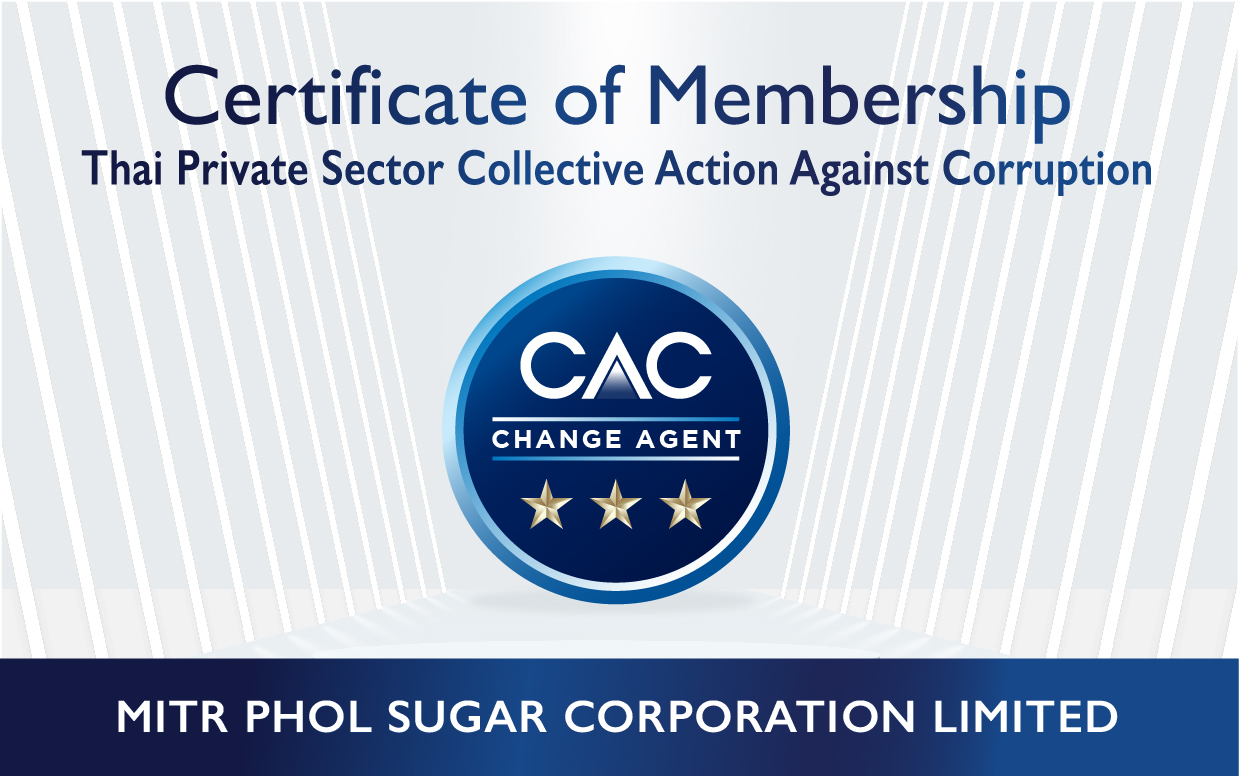
Mitr Phol Sugar Corporation and subsidiary companies are committed to operating the business on the foundation of honesty, transparency, justice, and equal treatments of all stakeholders, in line with the group’s Corporate Governance and Code of Conduct. In accordance with this commitment, the group has drafted an Anti-Corruption Policy for which the company’s directors, consultants, management, and employees must be in strict compliance, which will lead to sustainable business growth.
Policy scope
1. The policy applies to Mitr Phol People which include all directors, consultants, management, and employees of Mitr Phol Sugar Corp Ltd., and its subsidiaries.
2. The policy applies to all business units, departments, sections, and work processes. It also applies to human resources management, including recruitment, selection, training, performance evaluation, compensation, and promotion.
Definitions
Corruption means the abuse of authority or any action performed in order to gain advantages or undue benefits either to the organization, oneself and or others. Corruption covers giving and/or accepting bribes, demanding or threatening for benefits, and causing conflicts of interest, whether with government officers, government officials or private entities or others.
Misappropriation means any action that leads to improper possession of the Company's assets, or any causes for damage to the Company, loss of property, opportunities, or any other benefits with the intent to seek benefits for oneself and others, which cover both cash and non-cash assets or any unlawful acts.
Financial statement Fraud means deviation of various reports in regard to financial information such as financial statements, financial records or non-financial reports, e.g. overall performance, in order to cover up the embezzlement or seek benefits for oneself or others, which results as inaccurate reports of the Company and causes damage to the Company both directly and indirectly.
Conflict of interest means performing duties that must yield outcomes or benefits in accordance with the Company's objectives, but instead benefiting oneself, relatives or any other persons, which compromise the interests of the Company, either directly or indirectly.
Facilitation payment means any small informal payment to government officers/officials provided solely to ensure that the government officers/officials shall comply with the procedures or to urge them to take actions in a more timely manner, while the procedures do not require their discretion but their legitimate authority concerning any legal rights of juristic persons such as applying for a license, requesting a certificate, and receiving public services, etc. The Company has no policy to make such facilitation payments that may lead to corruption.
Sponsorship means providing financial aids, goods, services or other in-kind supports to organizing events, activities, individuals, agencies, associations or any others with the objective of commercial benefits, promotion of business relations and images, including the good reputation of the Company.
Charitable contributions mean providing supports in form of financials, goods, assets, services or other in-kind contributions to other activities, individuals or entities with the objectives of public charity or for public benefits without expecting benefits or anything else in return.
Political contributions mean providing supports in form of financials, resources, services or other in-kind assistances to aid political activities, political groups or any politician or group, either directly or indirectly, such as loans, monetary donation, giving goods or services, advertisement to promote or support, or purchase of tickets to join or finance fund raising events, etc.
Government officers/officials mean public servants or local administrative officers with full-time positions or salaries, operators in government agencies or state enterprises, local governors, deputy local governors, assistant to local governors and council members of local administrative organizations, officials under the Local Administration Act, or other legal officials, including committees, sub-committees, employees of government divisions or agencies or of state enterprises, and individuals or groups of persons, which are entitled by law to exercise power or authorized with jurisdiction established in the government system, state enterprises or other state affairs, as well as individuals holding political positions, judges, constitutional courts, officers in independent organizations and the National Anti-Corruption Commission (NACC).
Responsibilities
1. The company Board of Directors is responsible for stipulating the anti-corruption policy and promoting the anti-corruption systems to be efficient, appropriate and up-to-date. The policy include procedures for reporting and filing complaints and investigation to ensure that the Executive Committee, management, and employees understand the importance of fighting corruption and promoting anti-corruption efforts as part of Mitr Phol's company culture.
2. The company Executive Committee and management are responsible for establishing anti-corruption systems and promoting the policy implementation, as well as ensuring regular communication to all levels of employees to promote an understanding of anti-corruption practices across the organization. The Executive Committee and management must also review such systems to ensure they are up to date and remain relevant to the business operations so that anti-corruption efforts can be carried out efficiently.
3. The Audit Committee is responsible for carrying out internal audits, compiling accounting and financial reports, risk management, processes, and practices, including to advise and follow-up the compliance with the Anti-Corruption Policy.
4. The Risk Management Committee is responsible for supervising, supporting, and providing suggestions for risk assessments related to fraud and corruption, as well as adequately and appropriately reviewing and following up on relevant measures and the up-to-date state there of.
5. The Audit Office is responsible for performing audits and checks to ensure all business operations are in compliance with the laws, regulations, scope of authority, and corporate policies. Before reporting to the Audit Committee, the office must also make sure that internal audits, accounting and financial reports, risk management, and processes and procedures are appropriate and adequate. Any advice and suggestions of the Audit Office should be reported to the Board of Directors.
6. Mitr Phol People are responsible and obliged to comply with this Policy, including other relevant policies, practices, and regulations. All parties must refrain from getting involved in corruption, whether directly or indirectly.
Guidelines
1. Mitr Phol People must not commit or engage in any action that involves any form of fraud and corruption in order to seek improper benefits for oneself or others, which may cause damage to the Company. Our personnel must also strictly comply with the law provision on anti-corruption in Thailand and other location where the Company operates business, including Mitr Phol Code of Conduct, Anti-Corruption Policy and anti-corruption prevention procedures.
2. Mitr Phol People must comply with the company’s regulations and practices, as well as local laws, regarding receiving or giving gifts, anything of value, hospitality, services or any other interests including donations for charitable and sponsorship, to ensure that such actions are not misconstrued as an act of bribery or conflict of interest.
3. It is prohibited to hire or appoint any incumbent government officers/officials as the Company's employees. In case of necessity to recruit, appoint and determine remuneration of former government officers/officials, the procedures must be transparent, in compliance with the law, and without the pursuit of any benefits in return.
4. Establish procedures for risk assessment regarding anti-corruption in business operation that could occur. Specify appropriate management approach.
5. Determine audit procedures to ensure that the internal control of accounting, data storage, including documents and records are accurate and adequate for recording in the financial report, and to affirm the effectiveness of the procedures in accordance with the anti-corruption and fraud measures.
6. The Internal Audit Office must report issues found regarding fraud, corruption, or any suspicious behavior urgently to the Chairman of Executive Committee and the Audit Committee in order to report to the Board of Directors.
7. Mitr Phol People must not neglect or ignore incidents that may involve fraud or corruption regarding the Company. It is thier duty to report such incidents to your supervisor or relevant departments to investigate. The identity of the person providing information or lodging a complaint shall be protected and kept confidential throughout the entire investigation process, in line with relevant policies.
8. The person under investigation or the accused shall be treated fairly and with respect to human rights. If the person is found to have engaged in fraud, corruption, or actions that violate the law, rules, and regulations, they shall face disciplinary action as stipulated in company policies or legal action as stated by law.
9. Employees who refuse to engage in fraud or corruption shall receive protection and be treated with justice. They shall not face a demotion or any negative consequences, even though their actions may have caused the company to lose business interests.
10. Regular reviews shall be conducted to ensure the policies are in line with the law, rules and regulations governing business conduct, as well as anti-fraud, and anti-corruption.
11. Communication, training, and education about anti-fraud and anti-corruption policies, as well as other relevant practices, should be carried out regularly, to instill awareness and commitment for employees to carry out their duties with caution and mitigate potential risks of fraud and corruption.
31 August 2023
Mr. Buntoeng Vongkusolkit
Chairman of the Board

Mitr Phol Business






สมัครรับข่าวสาร !
ข้อมูลเกี่ยวกับโปรโมชั่น
และประชาสัมพันธ์ผลิตภัณฑ์ใหม่


